
The Vinyl Connection Music Catalogue is quite large, but relatively simple in structure.
Artist name, Album name, Year, Format, and a general field into which I push anything from colour of the vinyl to a bonus DVD. There are all kinds of useful or interesting things that could be included: date of purchase, original or re-issue, some kind of ‘play count’. The possibilities are many. But the one that would be very useful for the ROCKIN’ ALL OVER THE WORLD project would be the artist’s Country of Origin.
Wanting to feature the great northern country of Canada, it would have been very handy indeed to sort the spreadsheet by country. Why bother, you ask. You’ve got The Band, Joni Mitchell, Neil Young, kd lang. What more to you want? Well, something a bit different.
OK, you reply, what about Crash Test Dummies, Cowboy Junkies, Barenaked Ladies, Sloan. All well and good, but still not quite there. The truth is, I would really like to surprise my Canadian friends with a left-field choice that might evoke a grin (or maybe a furrowed brow). Something, you might say, that is the opposite hemisphere to Bryan Adams.
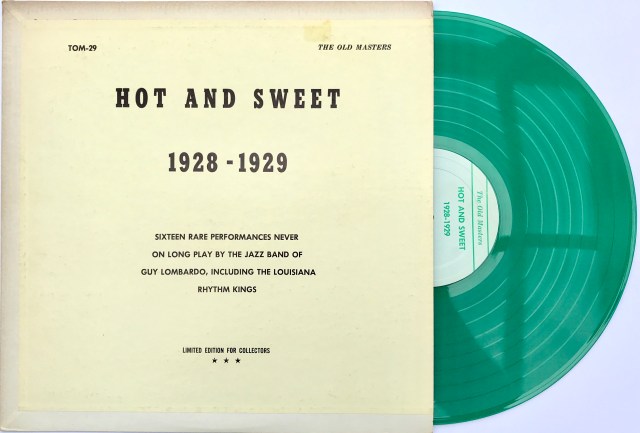
Guy Lombardo. Active from the 1920s through 50s. I have a couple of albums and one of them is early jazz and also an early coloured vinyl artefact. But the music isn’t especially memorable.
Oscar Peterson. How many folk realise the famed jazz pianist of the flying fingers was born in Montreal? Though I enjoy Oscar very much, I’m not really in the mood to do a jazz LP right now.
After an intriguing hour of research, I narrowed it down to a handful of bands I really like and would enjoy sharing.
The Besnard Lakes. Fascinating band who could broadly be described as “Indie”, but one could add post-rock, psychedelic or even shoegaze. Dense involving music that rewards immersion.
Karcius. A band fusing a range of styles and influences: Rock, Pop, Classical, Jazz, and Ambient. I only discovered this Montreal band a year or two ago and have two albums, both of which are outstanding.
Druckfarben. Also a new band to me. Wonderfully creative and engrossing progressive music. Sounds like they’ve absorbed lots of influences from my favourite prog artists and mixed up a tasty new dish.
And the winner is…
Nash The Slash!
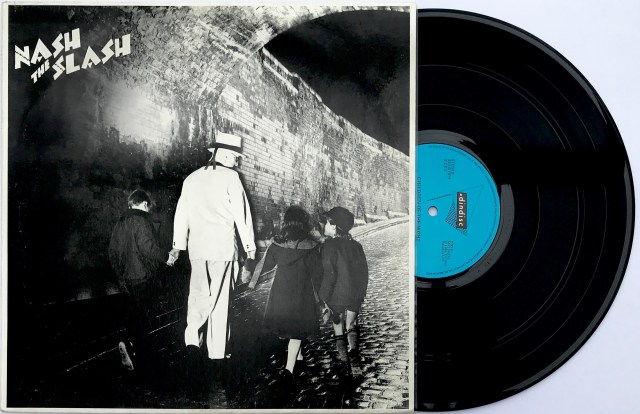
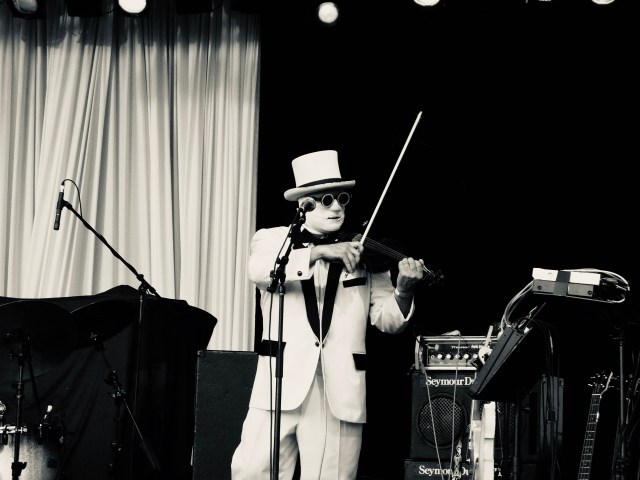
Yes, the mysterious and (kind of) anonymous multi-instrumentalist who played violin, keyboards, mandolin, while performing with a bandaged head à la The Invisible Man.
Nash The Slash.
Born James Jeffrey Plewman in Toronto in 1947, he played live regularly, recorded soundtracks to silent films, and released a dozen or so EPs and LPs. Retiring—or as the man himself put it, “rolling up the bandages”—in 2012, Nash felt he had done his time on stage, observing that the contemporary scene had little place for eccentrics. Costumes and instruments were donated to the National Music Centre in Calgary, Alberta.
I have one Nash The Slash album. It’s a ripper, from the disturbing cover story to the slightly unhinged musical excursions.
The Allmusic guide describes Nash’s music as a blend of Gary Numan, early Pink Floyd, Jean-Michel Jarre, and The Stranglers. The first of those is clearly audible and not especially mysterious as Nash toured the UK in 1980 supporting Mr Numan. Not long after he began recording his second long player, a totally solo effort entitled Children Of The Night (1981).
Opening with a rock roar, “Wolf” soon morphs into a violin-led romp quoting from several compositions, including Prokofiev’s Peter And The Wolf. Although the simple programmed percussion is a tad monotonous, the slashing fuzz mandolin and other distorted strings are brilliant. Segueing into a jaunty (yet slightly sinister) cover of Jan and Dean’s “Dead Man’s Curve” is, um, unexpected. It’s like a mash up of a surf ditty with “Monster Mash”; so daft you can’t help but chuckle.
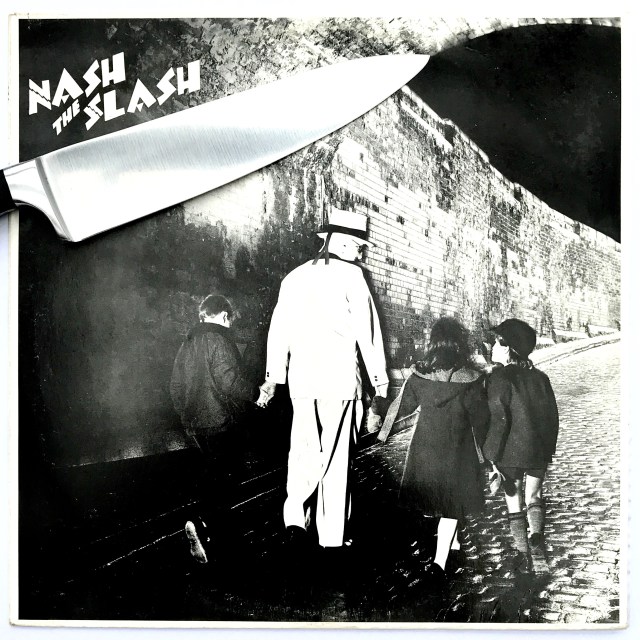
The title track has a threatening vocal over a repetitive Jean-Michel Jarre synth beat; these “Children of the Night” are doubtless the sweet little ankle-biters featured on the back cover of the LP.
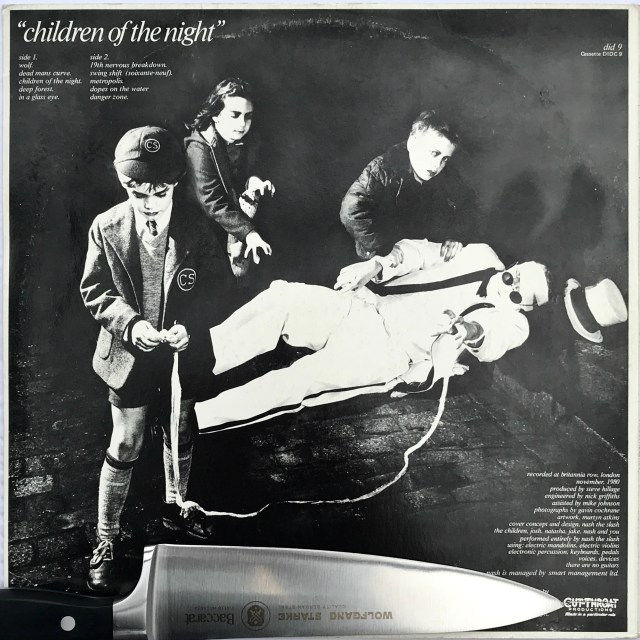
“Deep Forest” is a brief instrumental interlude, leading into “In a Glass Eye”, a really interesting collection of violin+effects with subtle underpinnings over a Casio beat. Nash’s singing is great, the sonic textures are exciting…a nightlife highlight.
Side two has the similar eclectic—or rather, eccentric—mix of originals and interpretations. Nash’s brilliant version of “19th Nervous Breakdown” manages to be both earnest and cabaret, while “Dope on the Water” would have to be a favourite on the Deep Purple tour bus.
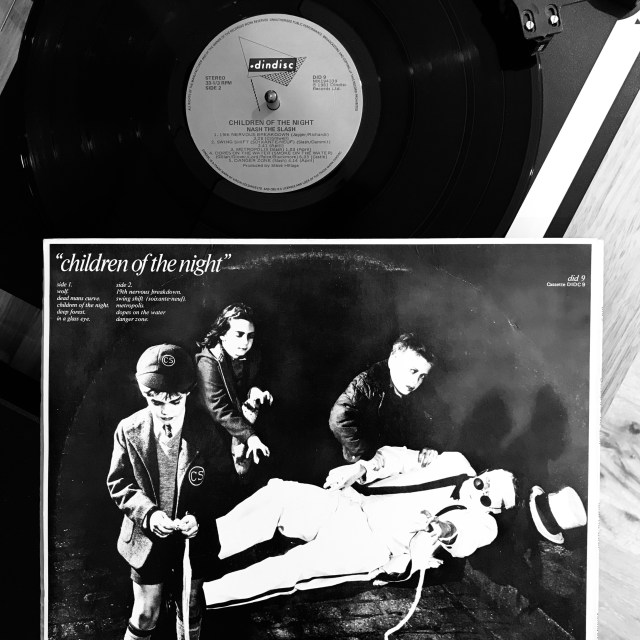
In fact it’s tricky to pick a favourite on the second side. The wonderful effects on “Swing Shift” show clear influences of producer Steve Hillage (Gong, solo; great guitarist). Another inventive little instrumental leads into Nash’s magnificent “Dope (Smoke) on the Water” (where he seems to be making up the lyrics after listening to the original on a small transistor radio). I would dearly love to have heard this in concert—Nash was a veteran live performer—but the chances are low as he died in 2014 at the age of 66. It is not known whether the musician was embalmed.
The “Danger Zone” (the final, brilliant, Yellow Magic Orchestra meets Merzbow track on Children of the Night), is a fitting epitaph to a clever, amusing and very entertaining album. So thanks, Nash The Slash of Ontario, Canada. You made me smile and dance. Under the bandages, I’m sure you were smiling too.
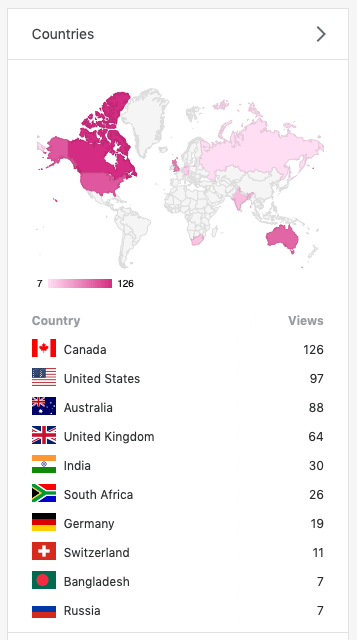
* The idea of Rockin’ All Over The World arose from WordPress stats, which show a delightful range of countries in the daily/weekly/monthly league ladder. This is #7 in the series. Other posts can be found by entering “Rockin’ All Over” into the search box on the right.


 vinylconnection.com.au
What a fascinating look at Nash the Slash.
If the line ‘You made me smile and dance. Under the bandages, I’m sure you were smiling too’ fails to motivate me to listen to this, it wont be due to any shortcoming in the writing of this piece.
Thanks and all the best for 2021.
LikeLiked by 1 person
Lovely, DD. And all the best to you and your close ones for ‘21.
LikeLike
I chose to listen to Dreams and Nightmares for two reasons. First, the title parallels a favourite of mine, Angels and Demons. Second, YouTube had the full album. Rah Rah for Nash the Slash.
LikeLiked by 1 person
I, for one, commend you for adhering to and maintaining the strict CanCon guidelines of every noteworthy* collection. It’s been ages since I head that Nash. Time to get ‘er in my ears again!
* every pun is intended.
LikeLiked by 2 people
Phew! Wouldn’t want the Investigation Team a-knocking on my door, Aaron.
With a bit of luck, enough Canadians will hit up the post that I will get to do another of those artists!
I’d love to post on The Besnard Lakes.
LikeLike
So post on the Besnard Lakes! Give ‘er!
LikeLiked by 1 person
Nash the Slash. I had never heard of him before despite the catchy name. Based on sampling some of the tunes, this a weirdly charming album! 🙂
LikeLiked by 1 person
That description is perfect, Christian. Wishing you a weirdly charming 2021!
LikeLiked by 1 person
Ha, thanks! 🙂
LikeLiked by 1 person
Well thanks for kicking the year off with this bit of peculiarity. Down Under do they have the expression “not wrapped too tight”? I’ve been listening via YouTube – -I was just beginning to find the repetitive synthesizer stuff, well, a bit mind-numbing, and then really enjoyed the covers, these goofy versions of “Deadman’s Curve, “19th Nervous Breakdown,” “Smoke on the Water,” fun and really catchy! Some of this artifact reminds me of that ancient era’s off-kilter humor, like King Missile’s “Cheesecake Truck,” weird but definitely fun. And a very talented violinist.
LikeLiked by 1 person
Chuffed you sought out Nash, Robert. Although it’s not an album you’d spin daily- or even weekly! – it is eccentric fun.
(That piece of vernacular has not penetrated this far south, Robert. Translation?)
LikeLike
Well, the expression is the usual rudeness about perceived mental problems – wrapped too tightly = repressed. Not wrapped too tightly = eccentric or odd.
LikeLiked by 1 person
You’ve utterly sold me on this one Bruce!
LikeLiked by 1 person
It’s gloriously potty, Joe.
LikeLiked by 1 person
PS: Off Topic I know, but did you get the vinyl release of Welcome Interstate Managers? it was pricey, but I managed it and it sounds better than ever.
LikeLike
I didn’t, but probably should have. Terrific album, so well done you!
LikeLiked by 2 people
Buriedonmars and I were just observing recently how fun it is to learn about Canadian music from blogging friends around the world – and Besnard Lakes, Karcius, and Druckfarben are all brand new to me, Bruce!
LikeLiked by 2 people
It’s cool, isn’t it? A mate in Seattle put me onto a Melbourne band not long back. It’s like an overseas mate visits for a BBQ in your back yard and discovers a new species of plant!
LikeLiked by 2 people
Strip my beaver pelt off, take away my maple syrup, break my hockey stick, drink all my beer and detoque me. I know the name well. Never heard a note. Total ignorance on my part. It takes another Commonweather to set me straight. CB is in disgrace,
LikeLiked by 1 person
Never, CB! Come out of the naughty corner, lad, and pick up thy stick. Your riotous response is exactly what the editor in chief was hoping for. Cheers, eh?
LikeLiked by 1 person
Melt my Igloo, release hungry moths on my one piece long johns, steal my bacon, hide my HP sauce, take the keys to my skidoo, empty my mosquito repellent, take away my concertina, make me stay inside during our two weeks of summer ..
LikeLiked by 1 person
“I want what he’s having”
LikeLiked by 1 person
I think I’d definitely have to label Nash the Slash an acquired taste. I checked out the video for “19th Nervous Breakdown” on YouTube: decidedly *creepy*! My Canadian music instincts align more comfortably with Joni, The Band, and Cowboy Junkies!
LikeLiked by 1 person
Sure, Nash belongs firmly in that short-lived series/category named “Curiosity Corner”. 😉
And certainly I should do something on Joni.
LikeLiked by 1 person
I was sure I’m gonna see some Rush action here and was hoping for the coverage of canadian excellent prog scene (Collectors, Maneige, Sloche) or one of the finest brass rock bands – Lighthouse. As You can see my expectations flew out of the window 😛 Which may be even better if this Nash the Slash delivers music at least half as intriguing as his persona, which I’m going to check eagerly 🙂 So thanks for the tip!
LikeLiked by 2 people
Glad to have confounded expectations, iwarti! Yes, I was tempted to “go prog” (though not Rush. Sorry to admit I cannot stand them) but took the more eccentric route on this occasion.
Thanks for visiting.
Ps. Next stop: Norway!
LikeLiked by 3 people
Never really delved into Mr Slash. However, I feel certain that when I was young, I tuned into a televised concert by Culture Club and said Nash was opening for them. Cheers for the look at a great (but not obvious) Canadian act.
LikeLiked by 3 people
Must trawl YouTube for some live footage of Mr Slash.
Glad you enjoyed it, jpr. It was indeed an attempt to steer well clear of the obvious!
LikeLiked by 3 people