
US AND THEM: WHY ‘DARK SIDE OF THE MOON’ IS STILL IMPORTANT
First published at Discrepancy Records; updated December 2023.
*
GENESIS
David Gilmour, guitarist and latter day captain of the dreadnought known as Pink Floyd, remembers a gathering at Nick Mason’s home in November 1971. The meeting was memorable as it was when Roger Waters, chief navigator of the band’s creative output after Syd Barrett wandered away into fields unknown, outlined his idea for a new project.
Roger remembers the occasion too. It was when he first pitched his idea for a concept album (no, the word was not always uttered with disdain), a suite of music “all about the pressures and difficulties that crop up in one’s life and create anxiety.”1 It was vital to have a new spark, a lantern to guide the band in Syd’s absence. The mercurial Barrett had been, as Waters said, “the heartbeat of the band.”2
It was the beginning of a long and winding voyage that would, ultimately, produce Dark Side of the Moon, a record whose storied history has made it one of the best known and most loved albums in rock. Why? Many reasons, but primarily because, then and now, it speaks to the big questions of existence… life, mortality, achievement, connection, alienation.
But it wasn’t an easy sell. From the time Syd Barrett, Waters, Mason and keyboard player Rick Wright formed The Pink Floyd, this quintessentially British 60s band were associated with a style of psychedelic space rock reflected in the song titles “Astronomy Domine”, “Set the controls for the heart of the sun”, and “Interstellar overdrive.” While these did not represent the entirety of Floyd’s lyrical reach, they became indelibly tattooed onto the persona of the band, much to Waters annoyance. “My big fight in Pink Floyd,” he recalled, (was) “to try and drag it kicking and screaming back from the borders of space, from the whimsy that Syd was into, to my concerns, which were much more political and philosophical.”3 Those concerns amounted to an unanalysed yet vividly painted existential philosophy, which is why we still find so much to connect with in the album.

THEMES
The tension between earth and space—along with the arm-wrestling engaged in by Gilmour and Waters—produced one of the great paradoxes of rock. Released in March, 1973, the astronomically named Dark Side of the Moon is an album that ponders, explores, and comments upon the human condition. It is noticeably light on songs about cars and girls. The listener doesn’t even have to scour the lyrics to detect the flesh and blood theme; it is there from the moment the stylus hits the vinyl as a human heartbeat, the metronome of our lives, fades in.
Lub-dub… lub-dub… lub-dub
What signals the arrival of a new life into the world? Breath. The very first independent action of the newborn child is to breathe, breathe in the air. The extended vulnerability of our young is unique to humankind, and although Waters was dismissive of “Breathe” (Classic Albums2)—describing the lyric as “Lower Sixth”, a reference to mediocre secondary school poetry—it nevertheless captures something basic and enduring about humanity. “Leave, but don’t leave me” speaks to the fear of abandonment while the accumulation of life experience through the senses is celebrated—or lamented—in the line “all you touch and all you see is all your life will ever be”.
A sense of haste, of busily rushing through life where activity leaves no room for reflection, is a major thread in Dark Side of the Moon. In “Breathe” it is “run, rabbit run”. This is followed by the sequencer driven instrumental interlude “On the run” (originally titled “Travel sequence”) whose wavelike cadences leads us into the chiming clocks that signify “Time”.
And you run and you run to catch up with the sun, but it’s sinking
And racing around to come up behind you again
Waters’ lyrics invite us to question our habits, interrogate our choices. What gives meaning to our lives? Is wealth what you crave? (“Money”). What about the values that drive choices? In “Money” the narrator is advocating looking after number one. Bugger everyone else. Directly after that is the fragmented yet powerful reflection of “Us and Them”. Perhaps a sense of duty is the highest ideal. “Listen son, said the man with the gun, there’s room for you inside.” Serve your country, put on a uniform, head for the trenches. Generals traditionally have no compassion for canon fodder, but the scarred soldiers will be cared for on their return, won’t they?
For want of the price of tea and a slice, the old man died.
Perhaps not.
It’s enough to drive you balmy. But what is normal anyway? Memories of Syd’s mental decline were vivid for Roger when he penned “Brain Damage”, a lament for Pink Floyd’s crazy diamond and a swipe at British uptightness. The song seems to be inviting us to abandon the drudgery of the everyday and migrate somewhere else. Not sure the bare crater-pocked surface of Earth’s minion celestial body is the most attractive location to pitch your tent.
There is a reason this album is not called “The Bright and Cheerful Side of the Moon”; we live, struggle, and eventually buy a ticket for that great gig in the sky. Along the way, perhaps we learn to be gentler with those around us, realising that really, all we have is ourselves, and each other. With global sales of forty-five million copies, and counting, Dark Side of the Moon clearly embodies a commonality, a shared experience, transcending culture and time itself.
Of course this is not just a concept album fossicking around in the detritus of existential philosophy. It is, first and foremost, a brilliant slice of rock music. The guitar break in “Money” soars thrillingly over its loping beat; “On the run” is built around a mesmerising synth sequence; some gorgeous sax introduces “Us and them” and imbues it with ineffable sadness. There are choruses we can sing along with, and hooks to hum. “Breathe, breathe in the air. Don’t be afraid to care.” The songs paint portraits of humanity in words and sound. And Dark Side of the Moon sounds great. Still. Waters, Gilmour, Wright and Mason were skilled musicians and were comfortable, like The Beatles before them, in using the recording studio as a creative playground.
PROGRESSIVE SOUNDS
Technology—both in terms of studio advancements (the LP employed the newly invented Dolby noise reduction system) or a novel instrument such as the VCS3 synthesiser—was important to Pink Floyd. In the fascinating “Live At Pompeii”2 film, there are revealing interviews, conducted as material for the new record is being tried out. Asked about their dependence on music technology, Waters talks about “using the available tools”, while Gilmour drily observes “the equipment isn’t actually thinking what to do; it doesn’t control itself.” When Waters comments on how you could give someone a Les Paul guitar, but “he doesn’t become Eric Clapton”4, his sarcasm is clear. It comes out of our heads, they say; we have ideas and the patience to realise them. The man controls the machine, and that mastery is the result, the reward if you like, of taking time to experiment. Gilmour is willing to bet they’d come off better in a showdown between the band and a bunch of un-named technology newbies. It’s a confidence permeating the record.

THE PACKAGE
For an album to achieve classic status, every aspect needs to be on the money. We’ve explored meaning, music and methods, but the look of a record is also vital. When you first encounter it, does this LP demand you pick it up? Does it invite, attract, nudge you towards further investigation? In this case, the answer is a resounding “Yes!”
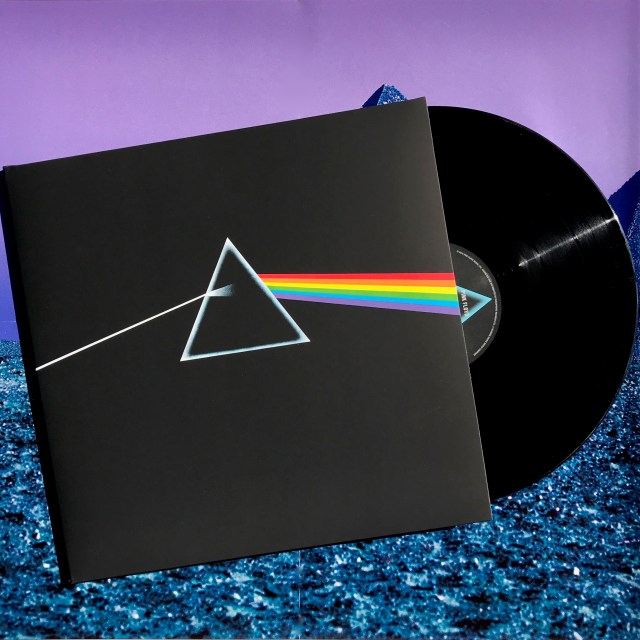
The simplicity of the Dark Side of the Moon sleeve design by the legendary Hipgnosis team has augmented the album’s timelessness. Although some first pressings had a sticker with the title and band name, others were devoid of any type at all. It was iconic, striking, and mysterious. When you opened the gatefold, you found the coloured spectrum continued across both panels, with the green band having blips just like a cardiac monitor. That heartbeat again. There were also extras—two posters and two stickers—that adorned many a bedroom wall… probably still do. And of course, there are the lyrics, neatly laid out to be scrutinised, memorised, pondered. It was, in design terms, a complete package that has inspired many variants over the years. As David Gilmour observed, “We knew The Dark Side Of The Moon was going to be more successful than anything we’d ever done. And the album cover tied it all together.”7
Designer Storm Thorgerson nods towards Rick Wright for providing part of the inspiration, recalling that the keyboard player requested something “simple, clinical, and precise” relating to the band’s legendary concert light shows. Roger Waters added the notion of running the coloured spectrum through the gatefold of the album, onto the back cover where an inverted prism converted the spectrum back into a ray of light.5 The circularity is like a meditation, a mandala of light, that complements the audio cycle of the final, fading heartbeat closing the record with a slow, regular pulse…
Lub-dub… lub-dub… lub-dub
In 1987 Roger Waters observed that the LP “finished the group off. Once you’ve cracked it, it’s all over.”6 He was wrong, of course. Nor has time dimmed the glow of Pink Floyd’s eighth studio album. It has just turned fifty, yet continues to speak across decades and generations, a shining and shadowy example of the consummate rock album. As long as people listen to music and think about life, it will continue to find a place as a treasured part of record collections everywhere.
REFERENCES
- Mark Blake “Pigs Might Fly: The Inside Story of Pink Floyd” [Aurum, 2007, p.176]
- Martin Longfellow (Director) “Classic Albums: Dark Side of the Moon” [2003]
- Blake, ibid. p. 176
- Adrian Maben (Director) “Pink Floyd Live At Pompeii—The Director’s Cut” [Universal Studios, 2003. Original release: 1972]
- Nicholas Schaffner “Saucerful of Secrets: The Pink Floyd Story” [Sidwick & Jackson, 1991, p.166]
- David Sinclair “The Q Sleevenotes—Dark Side of the Moon” [Q Magazine, publication date unknown]
- Mark Blake “Us And Them: The Authorised Story Of Hipgnosis” [Bonner, 2023, p. 138]
*

*
If you missed instalments of 73 FROM ’73 these links will take you there.
Hope you enjoyed the journey!
Vinyl Connection will return for its eleventh season in 2024
*


 vinylconnection.com.au
I thought about this yesterday but was too timid to essay a guess. A fine choice.
LikeLiked by 2 people
Thanks DD. As we tick away the moments the make up another year, all the best to you and yours.
LikeLiked by 1 person
All the very best to you’ the boy’ and MsConnection. Happy New Year.
LikeLiked by 1 person
I was pretty sure this was where you were going . . . given what had come before . . . but glad to see such a good choice confirmed. It would be my own pick, too.
You made me look at my own 1973 collection, in depth. I think my Top Twenty would look thusly, right now . . .
20. Stevie Wonder, Innervisions
19. Desperado, Eagles
18. Isaac Hayes, Joy
17. John Cale, Paris 1919
16. Can, Future Days
15. Various Artists, The Harder They Come OST
14. Marvin Gaye, Let’s Get It On
13. Focus, Live at the Rainbow
12. Fela Kuti, Gentleman
11. Selling England by the Pound, Genesis
10. Larks Tongues in Aspic, King Crimson
9. For Your Pleasure, Roxy Music
8. Quadrophenia, The Who
7. Countdown to Ecstasy, Steely Dan
6. Cosmic Slop, Funkadelic
5. Brain Salad Surgery, Emerson, Lake and Palmer
4. A Passion Play, Jethro Tull
3. Here Come the Warm Jets, Eno
2. Band on the Run, Wings
1. Dark Side of the Moon, Pink Floyd
Congrats on another year of marking the half-century! Well done you!
LikeLiked by 2 people
That’s great, Eric. What a fine list!
How the heck did I overlook Eno’s debut? That’s the problem with proofing your own work, eh? And having over 300 to choose from. 🙄
The original ‘draft’ lists included one for Prog, one for Live albums and another for Soundtracks. But as the clock ticked, those were abandoned. So I’m delighted to see a couple that would have made the supplementary lists on yours. In particular Focus (an excellent live set), The Harder They Come OST, and Tull’s Passion Play.
Thanks for your support. Now, where’s that 1974 spreadsheet…
LikeLike
It’s obvious really when you think about it. Also it is pretty much devoid of the pomp associated with concept albums. I’ve spent all year listening to different versions of this including Roger’s new version which is better than I feared and in every incarnation it is fascinating. I really thought you’d go more obscure but in reality anything you chose would have to be compared to this and then well, it’s a whole piece, music, lyrics, package and tour.
LikeLiked by 2 people
You got it, Mister! This list closely resembles my own tastes, with ‘other influences’ minimised (though they can never be totally eliminated!). I see Eric has bashed out a list. Would love to see yours!
LikeLiked by 1 person
Okay I will play my top few? Accepting that Dark Side is a given:
Steeleye Span – Parcel of Rogues
John Martyn – Solid Air and Inside Out
Ash Ra Tempel – Join Inn
Hawkwind – Space Ritual
Horslips – The Tain
Fairport Convention – Nine, members spanning three continents and not a single original member present for the recording, this may actually be a tribute band, but it’s a great album.
Free- Heartbreaker
Genesis – Selling England by the Pound
Mac and Wings – Band on the Run
Roy Harper- Lifemask
Blue Oyster Cult – Tyranny and Mutation
Ian Matthews – Valley Hi
There are others I am sure but this was off the top of my head with some fact checking for dates. I am particularly fond of Valley Hi as it was produced by Nesmith and has the original arrangement of Seven Bridges Road the Eagles stole.
LikeLiked by 1 person
Plenty of overlap and a goodly number of new entries. More folk-rock is one genre I notice is strong on your list; well deserved too.
Great seeing Join Inn polling well. It placed #59 for me but could easily have been much higher.
A couple of your entries are albums I have but simply don’t know well enough. The Roy Harper is a good example. Too many records is certainly part of the problem! Anyway, thanks a lot for adding to the richness of the exercise by offering your own take. Got much from ’74? 😉
LikeLiked by 1 person
I just looked in the neglected database and I have others from 73 I would have added. The Caravan is essential and yes I have some from 74 that would be worth a mention. It’s a good excercise I looking back. The Harper is a good listen but I’m biased and I love me a some folk rock and this middle 70s period was an important time for the genre.
LikeLiked by 1 person
No argument there. 🙂
I seem to have phases where I top up on UK Folk-rock and periods of abstinence. Glancing at my ’74 holding (a daunting 300+), I don’t see a huge number of folk rockers, though there’s lots of jazz and prog!
LikeLiked by 1 person
There’s a Sandy Denny, Thompson and Steeleye in there I believe
LikeLiked by 1 person
Got the Richard and Linda, and Now We Are Six – both contenders. And thanks for the Sandy top. Helped me locate yet another inaccuracy in my three decade old database!
LikeLiked by 1 person
Aah the database, another bigger list, I may have given up.
LikeLiked by 1 person
#1 – really no other choice. I abandoned it for years but revisited it when it turned 50. Even though I’ve known the album almost all of my life, I’m still shocked when I listen to it.
LikeLiked by 1 person
That’s a kind of Hall of Fame vote, isn’t it?
LikeLike
Thank you for this splendid deep dive Bruce, was a real bright part of my December. And now…consider going in another direction and do top 23 of ‘23, can you imagine that? Going the other way ha ha? That would be a real challenge wouldn’t it? I’d be hard pressed to list more than 10 records from ‘23 I even know.
LikeLiked by 1 person
Yeah, magazines and such can do that. Some bloggers do too. Respect to them!
Thanks for coming on the journey, Bill. Appreciate it.
LikeLiked by 1 person
Like a lot of the albums you featured I have some fond memories of this record when I first heard it. The time, place etc. are firmly planted in my brain. An album lovers dream. Great work on all this Bruce. Thanks for making time for it. Appreciated. Off to look at the dark side of my eyelids.
LikeLiked by 1 person
Rest well, mate. But if you dream of electric sheep, see your IT manager immediately.
LikeLiked by 1 person
Thanks for the thought. It sending me with a grin.
LikeLiked by 1 person
Great choice and a great read. Not a huge album for me but I do enjoy the occasional listen. Funnily enough, I gave it a rare spin a couple of days ago. Inspired by watching the Hipgnosis documentary which I recommend if you haven’t seen it.
LikeLiked by 1 person
The Hipgnosis doco is certainly on my list, Scott. Looking forward to it.
Thanks for the feedback, too. Appreciate that a lot.
LikeLiked by 1 person
Albums I’d have picked for this year that weren’t on your list. Budgie, Mott The Hoople, Nazareth and Montrose albums from this year are all faves.
LikeLiked by 1 person
I do have Budgie and Mott, but don’t really know either well enough for them to have been contenders. I will, however, pull them for a spin in honour of HMO.
LikeLiked by 1 person
I enjoyed your authoritative essay — during my lifetime, which began a couple decades after it was recorded, the album has always been planted in the landscape, a kind of fixture like Apple or Exxon Mobil, but I never understood its cultural context. So thank you for a very “approachable” explanation! Best wishes to you for the new year, RPT
LikeLiked by 2 people
Thanks Robert, and all the best to you too.
I’m delighted you enjoyed the essay. Nice to stretch out a little!
LikeLike
Well said about the packaging acting as the silent salesperson, Bruce. You’re right, this fits the AIDA marketing model perfectly:
Attention immediately acquired by the cover,
Interest builds as they read the gatefold,
Desire to purchase grows,
Action taken as soon as humanly possible to invest in the LP!
LikeLike
I APPROVE OF THIS MESSAGE!!! 🙂
Great post!
I guess if I could only pick one of my top six albums of 1973, it would be Pink Floyd’s “Dark Side of the Moon” as well (the others in this group are Steely Dan’s “Countdown to Ecstasy”, Stevie Wonder’s “Innervisions”, Skynyrd’s “(Pronounced ‘Lĕh-‘nérd ‘Skin-‘nérd)”, Elton John’s “Goodbye Yellow Brick Road” and Paul McCartney’s/Wings’ “Band On the Run”).
Not only does TDSOTM take me back to the very beginning of my music journey – a time where I didn’t understand or speak one word of English – but to me, it remains one of the sonically most compelling albums of all time.
Happy New Year to you and your loved ones!
LikeLiked by 2 people
Vielen Dank, Christian. Wishing you and yours everything good for ’24.
LikeLiked by 1 person
It is like the band members said: the equipment does not really think what to do, a Les Pauls does not make you Eric Clapton, and… a brilliant review like this does not write itself. Congrats Bruce, and thanks for all the work. Up to the best 74 of 74′ now! Cheers, Guy
LikeLiked by 1 person
Appreciate that, Guy. And yes, sucker that I am, a 74 From ’74 is on the books. 🙄
LikeLike
[…] And the #1 album of 1973 is…? […]
LikeLike