
Nick Drake had precious little success during his brief lifetime. None of his three albums reached the wider audience he hoped for and his descent into depression made isolation his preferred state. Drake did not perform his music live, had acquaintances rather than friends, made little conversation and had no intimacy other than a tortured communion with his own mind. So how is it that his second album, 1970’s Bryter Layter, radiates a melancholy beauty and melodic richness that has made it an enduring favourite?
Part of the answer lies in the way Bryter Layter eludes easy categorisation. It is not really folk, neither is it rock. Yes, Drake sings and writes songs, but the LP does not feel like a singer-songwriter record. It’s more like a poet shyly showing you an exercise book of neatly written lines, illustrated with water colour images evoking both pastoral beauty and inevitable loss.
But before we get overly Romantic, let’s listen to the music. Because what Bryter Layter offers is a rich collection of songs (and some instrumentals) that somehow manage to glow like the darling buds of May while ever reminding us of Autumn’s fading colours. (We’re in the Northern Hemisphere, of course; Nick Drake was very English indeed).
The LP opens with a brief instrumental flowing around Drake’s cascading guitar lines. The rhythm section of Fairport Convention members Dave Pegg (bass) and Dave Mattacks (drums) is limber and sensitive. Robert Kirby’s orchestrations are immediately noticeable for those whose Nick Drake journey started with the more spacious Five Leaves Left. Personally, I’m not entirely sure about the brass, but otherwise the arrangements certainly counterbalance the introversion of the songs themselves. “Hazey Jane II” almost rocks, aided by Richard Thompson’s guitar. “At the chime of a city clock” has Drake’s observations of London, where he moved to be closer to the music scene. How did that go? Here’s a couplet from the song:
Stay indoors, beneath the floors
Talk with neighbours only
So not exactly a party animal, despite the chirpy saxophone decorating the song.
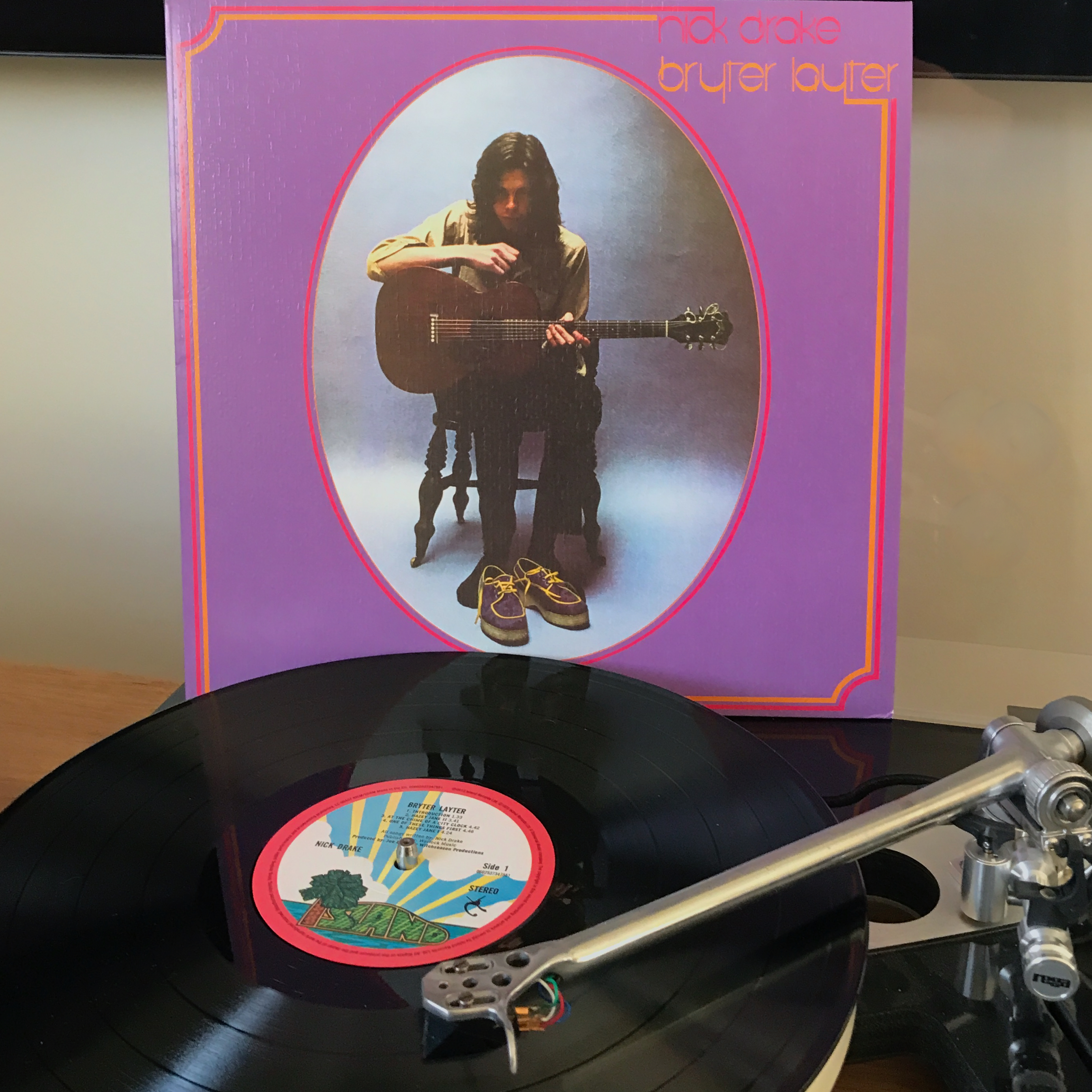
A variety of musical textures is what gives Bryter Layter its enduring charm. In his wonderful book “Electric Eden: Unearthing Britain’s Visionary Music”, Rob Young observes that the album is “a curious concoction of fluid, jazz-tinged folk-rock — melancholy with a desperate edge”. In “One of these things first”, Nick wonders about the things he could have been. The feel of a restless, homeless poet feel pervades many of the songs; he’s curious but separate.
The album’s epilogue is “Sunday”, a pretty, flute-driven instrumental. But just before that is the lovely, reflective “Northern Sky”. Graced by John Cale’s layered keyboard parts, this song somehow manages to be downbeat and—dare we say it?—hopeful.
I never saw moons knew the meaning of the sea
I never held emotion in the palm of my hand
Or felt sweet breezes in the top of a tree
But now you’re here
Brighten my northern sky
As we continue to marvel at Nick Drake’s singular talent some five decades after his death, as the accolades he both desired and shunned continue to accumulate across time, as his reputation continues to grow, perhaps it was indeed a case of Bryter Layter. Though not for Nick.

First published at Discrepancy Records. Reposted with kind permission.


 vinylconnection.com.au
My friend Janna K. owned four cds. Three of them by Nick Drake and one of calypso music by the actor Robert Mitchum. I have the cd’s now, but I never got around to listening to them. But, after reading your post, I suppose now is as good a time as any.
LikeLiked by 2 people
There’s a reflective quality to all Nick Drake’s music that may fit with a reminisce.
Thanks for visiting, Geo.
LikeLiked by 1 person
Great article, revisiting the album right now!
LikeLiked by 2 people
Thank Rick. Love it when a post catalyses a listen!
LikeLiked by 1 person
While I immediately recognized his name and knew Nick Drake died at a very young age, I’ve yet to explore his music. Based on your great review and sampling some of the songs on “Bryter Layter”, I’ve written down his name right away. His airy vocals remind me a bit of Donovan.
LikeLiked by 2 people
Super, Christian. Yes, Nick was in the acoustic folk singer/songwriter tradition that Donovan helped create. One could almost say that Nick was Donovan’s depressed love child. His small output is, however, really worth spending time with.
LikeLiked by 1 person
Im a big fan of Nick Drake and, despite growing up in a house full of music from the 50s, 60s, 70s and 80s I only found Drake by accident on YouTube one night. Your description: “It’s more like a poet shyly showing you an exercise book of neatly written lines, illustrated with water colour images evoking both pastoral beauty and inevitable loss.” Is perfect. Great post.
LikeLiked by 1 person
Thank you very much for those kind words. And I’m also glad for you that you stumbled upon ND. Sometimes the mythology around an artist who died young drowns out the music, but I don’t think that is the case here.
LikeLiked by 1 person
Love this album, but was really intrigued by your diamond-sharp, precise description of it Bruce. Seems no one has ever come out in favor of the brass, to my knowledge. I’ve never minded it, it just “is.” Didn’t know Cale played on that number! Or even the Fairport Convention folks.
LikeLiked by 1 person
Thanks Bill. Yeah, Drake was well regarded by other musicians, and indeed the small number of punters who found his albums. Sadly, however, not by himself.
LikeLiked by 1 person
[…] with fellow blogger Bruce (Vinyl Connection) in July 2024 about Nick Drake after he had published a post about the English folk singer-songwriter’s second album Bryter Layter. At the time, I […]
LikeLike