
“Most of you won’t like this, and I don’t blame you at all”
– Lou Reed, cover notes to Metal Machine Music, released July 1975
“An appalling rip-off”
– Critic William Howard in the Boston Globe, 1975
“Worst album by a human being”
– Rolling Stone 1975 end-of-year poll
“Anybody who got off on The Exorcist should like this record”
– Lester Bangs, Creem Magazine, March 1976
“A vast industrial howl”
– Magnet: Real Music Alternatives
“Confronting Metal Machine Music from front to back in one sitting is an experience both brutal and numbing”
– Allmusic Guide
“An exhilarating listen”
– Pitchfork, December 2017
*
One of the most polarising and misunderstood albums in rock history just turned 50, prompting a stylish re-issue for RSD 2025.

This is a vinyl re-issue from 2010. I’ve only seen the original once since my record store days, and the vinyl was very scuffed. Can’t stand surface noise, so didn’t buy it.
Comprising four sixteen-minute sides of distortion, feedback and noise without a trace of a human voice, Metal Machine Music was a late-night solo experiment undertaken by Lou Reed in his New York apartment. Using guitars, guitar amplifiers, microphones and a four-track tape recorder, Reed set up the instruments with different tunings and propped them against the amplifiers. The noise known as feedback began… and continued. The neighbours must have loved it.
Reed was, of course, familiar with feedback.
I had always loved that sound. I did tons of shows with the Velvet Underground where we would leave our guitars against the amps and walk away. The guitars would feedback forever, like they were alive. Metal Machine Music was just me doing that—lots of it.*

Thurston Moore of Sonic Youth is a big fan, and freely acknowledges the influence of MMM on his own guitar sound. Moore contributed quality liner notes for the swanky 50th Anniversary re-issue. He insists MMM is “utterly listenable” when positioned, in musical terms, within the context of “Experimental, Drone, Noise, Musique-Concrète, Aleatoric, Anti-Music recordings.” This neatly explains how Lou’s art project bemused and enraged fans of “Walk on the wild side”. MMM almost cost me my first record shop job after I insisted a customer requesting “Lou Reed’s latest” actually hear a sample on the shop stereo. After he left, silent and ashen-faced, the owner was distraught. “That was probably our only chance to sell it!” he wailed. And indeed, MMM had one of the highest return rates in recorded music history. It is very likely that the album cover contributed to the confusion—or perhaps that should be misdirection—experienced by the record buying public. Both front and back cover photos show Lou apparently on stage. The back one has him in front of a microphone. Yet there are no songs. Similarly, including the word “Music” in the title did rather support an expectation of aural stimulation deploying rock vocabulary. Nope. This was a kind of maxed out minimalism. As Lester Bangs said, “If you ever thought feedback was the best thing that ever happened to the guitar, well, Lou just got rid of the guitars.” What’s more, the list of equipment on the back is fictitious; a joke, Reed later admitted. Not sure how many punters laughed at that one.
So here I am—by my own choice— presenting MMM once again.
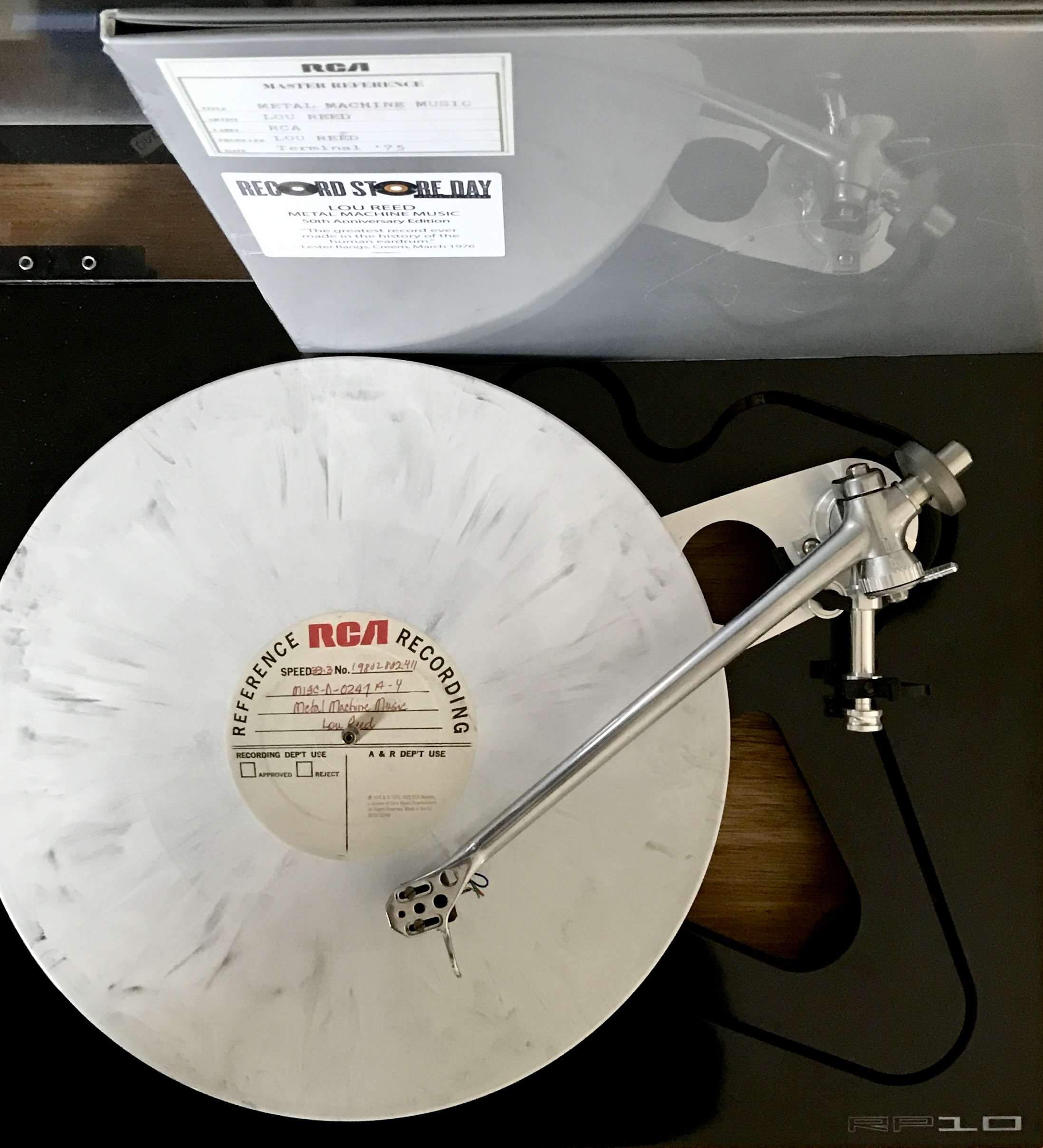
The 2025 cover is a ghost version of the 1975 original, hinting at the artist’s presence in outline. Pretty vinyl, isn’t it?
Lester Bangs wrote a great article on the album in 1976. He viewed it as a hit of vitamins, considering regular doses therapeutic.
When you wake up in the morning with the worst hangover of your life, Metal Machine Music is the best medicine. Because when you first arise you’re probably so fucked (i.e., still drunk) that is doesn’t even really hurt yet (not like it’s going to), so you should put this album on immediately, not only to clear all the crap out of your head, but to prepare you for what’s in store the rest of the day.
MMM is rather like a mental enema, driving out whatever is clogging up the psycho-emotional system. Yet when you surrender to the void a savage beauty emerges. Not so much the music of the spheres but the sound of a star collapsing. It is right and proper to have a health warning accompany the record, as I mentioned in a piece on Lou Reed written soon after his death in 2013.
Metal Machine Music is a guided meditation for a fucked-up, increasingly dystopian world. Like the evening news, social media, attack drones and AI it is simultaneously terrifying and exciting.
Lou Reed never backed away from his feedback magnum opus. He knew it had a lasting impact on avant-garde and noise music and that for a select group of intrepid musical adventurers~ it would continue to blow minds for generations. Listen to Sonic Youth, Merzbow, or Godspeed You! Black Emperor.
For everyone else, it’s the record to put on when you want all the guests to leave your party.
**
* David Fricke. Notes for the 2000 CD re-release of Metal Machine Music (Buddha Record, BMG, RCA).
~ In 2002, Berlin-based experimental art-music ensemble Zeitkratzer transcribed and performed MMM. In 2014 they released an astonishing acoustic interpretation of the work. This version—utilising woodwinds, brass, strings and percussion— encompassed all four parts of the original album. At first it sounds like an orchestra endlessly tuning up, before morphing into diabolical chamber music—less chilly than chilli. Then, as you release, something magical happens. The acoustic instruments find light and shade, producing movement, nuance, and unexpected moments of great beauty. It really is quite fabulous.

***
This is an expanded version of an article that simultaneously appeared at Discrepancy Records.


 vinylconnection.com.au
Trying to be sardonic rather than cruel, I ask, did you pick this from the bargain bin?
Anyhoo, I might dip an ear in these turbulent waters with the Zeitkratzer version.
Thanks Bruce.
Be well and do good,
DD
LikeLiked by 1 person
I wish, DD! Nope. I’ve paid full freight for the vinyl re-issue, the 50th anniversary AND the CD. I actually find it fascinating… but the Zeitkratzer version is much more listenable. See if you can find a way to start with side 2. 🙂
LikeLiked by 1 person
I’ve never heard this before. Listening to Part 1 right now. I agree with Thurston, utterly listenable. Although I also listen to a lot of Sonic Youth.
LikeLiked by 2 people
Brilliant, Jeff. Thank you most sincerely for verifying my long-held belief that experimental or ‘out there’ music is all about the path we take to get there. (eg: Miles’ Bitches Brew.) You brought your Sonic Youth ears and immediately ‘got it’. I’m delighted.
LikeLiked by 2 people
Sonic Youth songs have more of a melody.
LikeLiked by 2 people
True. I’ve always thought of the feedback interludes in sonic youth songs as ‘the guitar solo.’ With that mindset, the feedback on MMM starts to sound like extended solo noodling. I hope to listen straight through the whole album soon to see what I think. The more directed feedback of the Dream Syndicate is ultimately more appealing to me.
LikeLiked by 1 person
This album seemed like some type of experimental project.
LikeLiked by 1 person
In the sense of not knowing exactly what he was going to end up with, sound-wise, yes. The “guitar against the amp + effects pedals” approach was always going to produce unpredictable results. But in terms of Lou knowing what he was doing and his goal, it was carefully planned, recorded, mixed and released (with a solid dollop of mischievousness). Have you listened, mostlyanything? What did you make of MMM?
LikeLike
I listened to the first track of MMM, and it sounds like 99% distortion. I guess it was purposely recorded that way.
LikeLiked by 1 person
It was.
LikeLike
I’ve deliberately avoided this one because I admire Reed’s work with the Velvets too much. He used white noise with them but he used it sparingly, as accent, not as a full meal. That being said, I’m the only person I know who admits to kinda liking “Revolution #9.” (It makes “Good Night” sound that much sweeter.)
LikeLiked by 1 person
You are certainly not alone, Pete. Rev 9 is rather fun, and does indeed sweeten “Good Night” even more.
I’ve even been known to enjoy som Yoko, in the right mood. Especially Yoko / Plastsic Ono Band.
LikeLiked by 2 people
What “mood” exactly?
LikeLike
Everything in moderation, except for The Beatles!🤣
On a more serious note, I think guitar feedback is a pretty cool effect, but the key is to use it selectively. One hour and 4 minutes of it makes me wonder whether Reed was high like a kite when he did his little experiment. ‘Metal Machine Music,’ regardless which part, makes ‘Revolution No. 9’ sound like a pop song by comparison!
LikeLiked by 3 people
I totally love Lester Bangs assessment: “If you ever thought feedback was the best thing that ever happened to the guitar, well, Lou just got rid of the guitars.”
And yes, Rev 9 is a walk in the park after this. 😅
LikeLiked by 1 person
I guess it does take a certain amount of courage to release an album like this one. Perhaps after having had three predecessors that did pretty well (“Transformer”, “Berlin” and “Sally Can’t Dance”), Reed wasn’t too concerned whether “Metal Machine Music” would sell or not. Frankly, also kudos to RCA Records for putting it out, though I just read they took it off the market rather quickly only three weeks after it had been released.
LikeLiked by 1 person
I understand that Reed actually requested that RCA release MMM on its ‘classical’ or western art music label. That would be have made more sense (as would a less misleading cover!).
LikeLiked by 1 person
RDD release cover is foil-your cool
LikeLiked by 1 person
Cheers. Vinyl is nice too! 🙂
LikeLiked by 1 person
First off, a great Bruce take. Second, I was and still am a Lou fan. I had all his records up to this one and after. The only reason I didnt acquire this was because of my financial state at the time. I was in teenage wasted land and because of that , Bangs words fit. I had a buddy who bought the record and probably wished he was in the record store when you gave a sample, great story. Cant make that stuff up.
Enough CB bullshit. I have never gave the record a spin,not out of any prejudice before examination, just got sidetracked. I might be in one of those “moods” you mentioned so I will give it a go. I know I have spent time in more frivolous ways. Again great take Bruce. Oh yeah I haveNeil Young’s ‘ARC’ does that fall into the same category?
LikeLiked by 2 people
Yes! Great get, CB. ‘Arc’ is exactly in the same category, exploring the noise-music boundary. Never managed to snag a copy (but did get ‘Weld’).
LikeLiked by 2 people
MMM having one of the highest return rates in recorded music history – this is probably no surprise. Thanks for a great read. The RSD release looks super-cool. Not an album I play too often but was very startled back in the 80s when I got it home. Didn’t return it though.
LikeLiked by 1 person
Well at least you didn’t fall for buying your third copy this RSD. Well done. 🤪
LikeLiked by 1 person