
If you read a straight-ahead description of Time Out by The Dave Brubeck Quartet, it all sounds terribly serious and highbrow. Recollections of Brubeck’s avant-garde compositional inclinations while a student, his work with French composer Darius Milhaud at Mills College, the unexpected pairing of Brubeck’s inventive, meticulous piano playing with the warm, glowing tones of Paul Desmond’s alto sax… all leading to the startling decision to record an LP of all-original compositions in different time signatures.
For those unused to musical terminology, the time signature tells the musicians how many beats of what note value are in each bar (or unit) of written music. Most rock—and indeed, most jazz—is in 4/4. Four crochet or single-beat notes in a bar, with an emphasis on the first and third: 1-2-3-4. (That’s not entirely accurate, but it gives you the idea.) A waltz is in triple time, 1-2-3, 1-2-3, giving pieces a characteristic flowing, gently swaying rhythm.
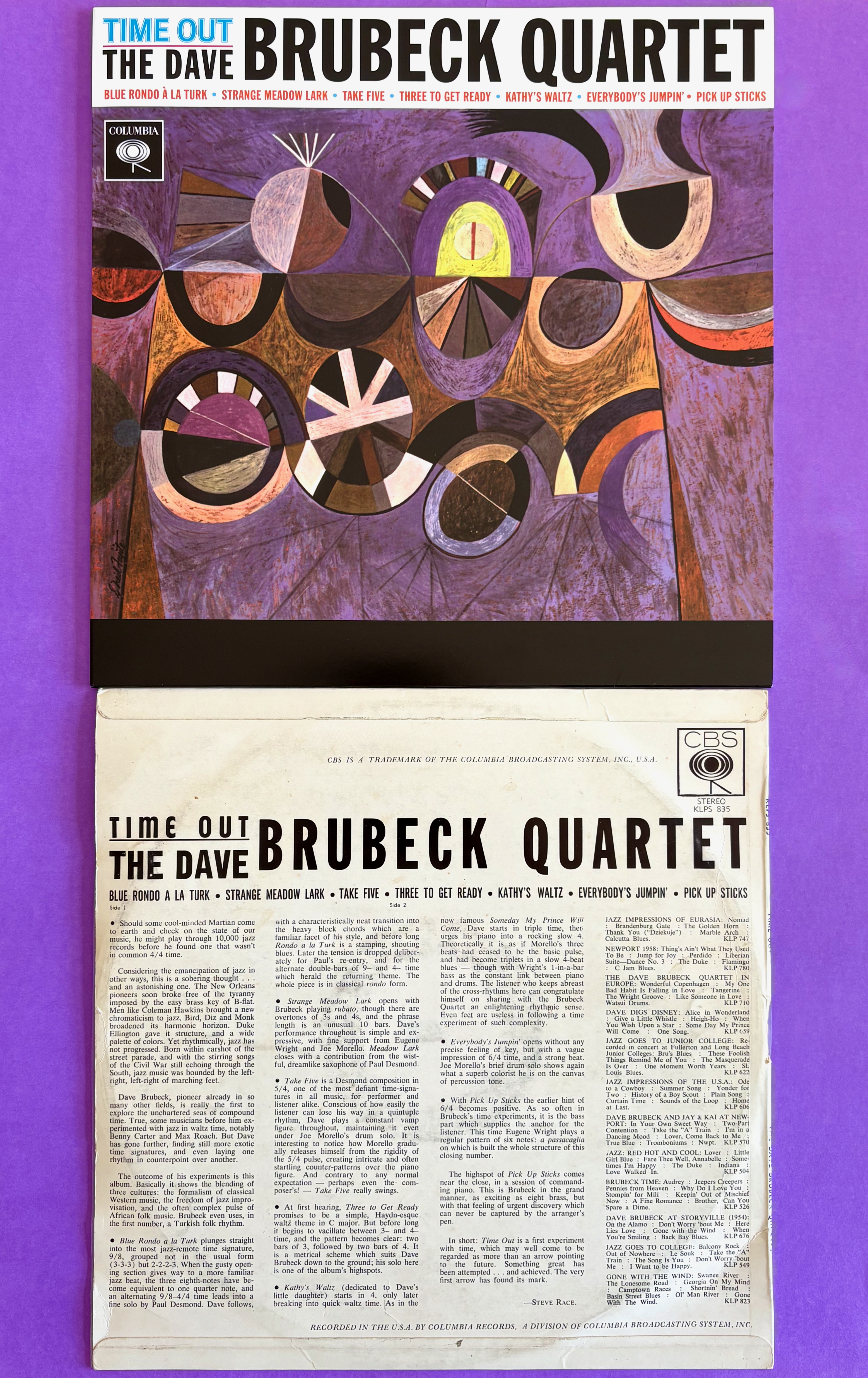
The original notes on the back cover of Time Out begin:
Should some cool-minded Martian come to earth and check on the state of our music, he might play through 10,000 jazz records before he found one that wasn’t in common 4/4 time.
There are plenty of other options, and Time Out covers many of them. But does this make it intellectual, cold, and distancing? Not a bit of it! This is one of the most accessible, tuneful and—above all—fun records in jazz. It even had the best known imprimatur of popularity, a hit single!
Opening piece “Blue Rondo a la Turk” sets the ball rolling with a fascinating rhythm that Dave Brubeck came across while wandering the streets of a Turkish town. “There were street musicians playing in 9/8 (1-2, 1-2, 1-2, 1-2-3)… I thought to myself, boy, when I get home, I’m going to write a tune…”. He did, and it’s rapid loping pulse immediately gets our attention. Of course the melody is memorable too. When Desmond joins in, echoing the simple repetitive melodic figure, there’s a liveliness that smacks of an exotic celebration. And when they start alternating between a bluesy sax figure and the original theme, you know you are in for a surprising and delightful trip.
On “Strange Meadow Lark” you’ll notice the solid underpinning supplied by the rhythm section of drummer Joe Morello and bassist Eugene Wright. (Wright, by the way, is not flashy but remarkably solid and reassuring; the perfect foundation for the excursions of Brubeck and Desmond.) Then there’s “Take Five”, the single mentioned earlier.
Desmond, who wrote the tune, offered this self-effacing insight into the piece:
If the problem of beating time to this disturbs you, and I don’t see why it shouldn’t, a good way is to tap your fingers, one at a time. (One is where the thumb is.) The melody, such as it is, was assembled rapidly in the studio and consisted of fragments which occurred to me here and there, mainly at a slot machine in Reno which produced an ominous but regular series of 5 clicks as the coins vanished. (The royalties from this will have to exceed $47 before I break even but then that’s show biz.)
If, like me, you are a fan of Gary Ross’s superb 1998 film Pleasantville, you’ll remember the key scene where Tobey Maguire’s character goes to the Diner and is quizzed by the teenagers about the arrival of colour in their world. And what is playing on the jukebox? “Take Five” by The Dave Brubeck Quartet. The music is superbly in sync with the dialogue; a perfect example of the time, the music, the moment. So is Time Out, an instant classic in 1959 and still delighting audiences today. To surrender to the obvious: it’s timeless.
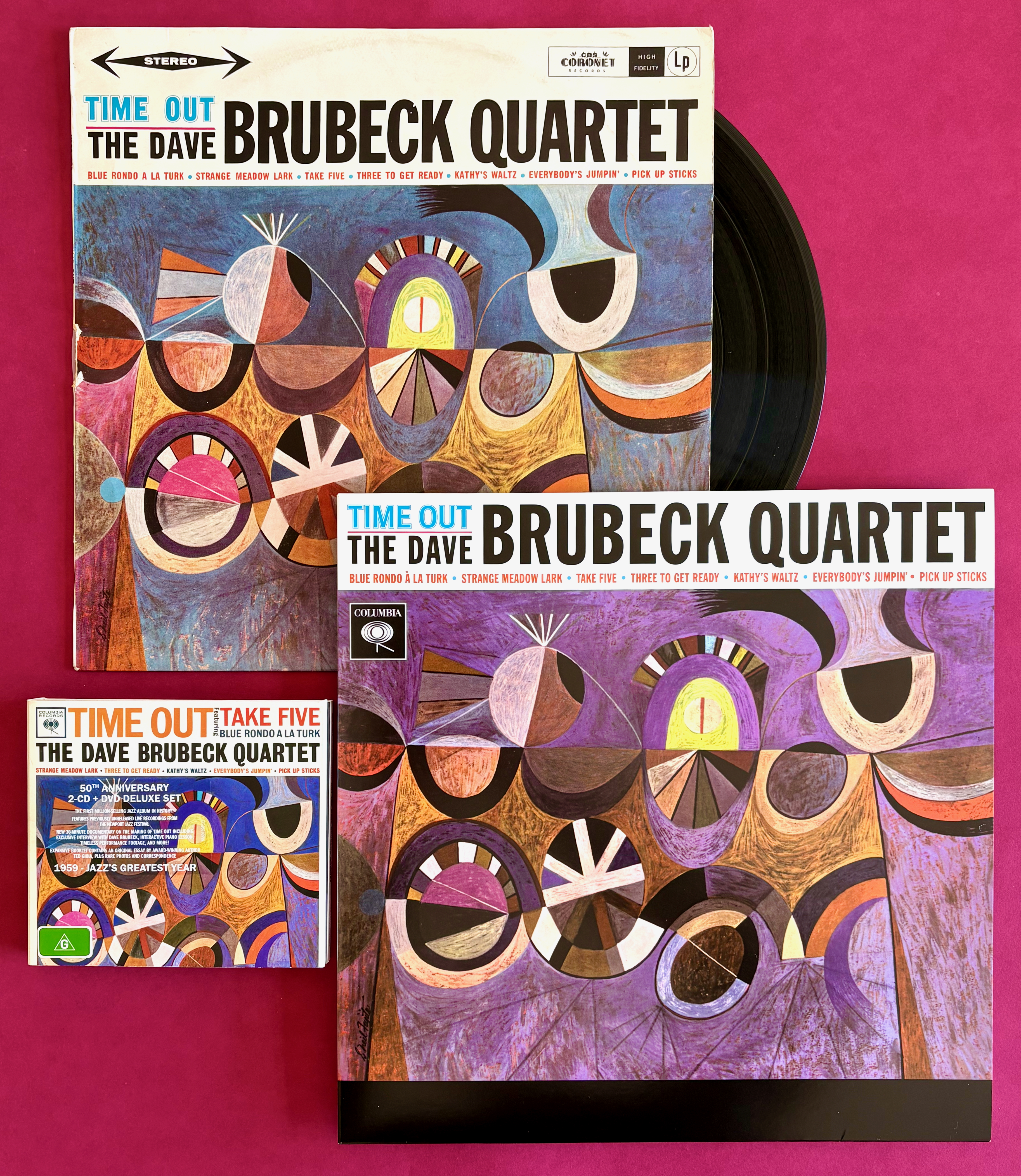
Quotes from cover notes by Ted Gioia (50th Anniversary CD re-issue, Sony Music 2009).
Originally posted at Discrepancy Records. Republished, with minor alterations, by kind permission.


 vinylconnection.com.au
Great post, bruce. I’ve had the album forever. Never knew anything about it’s creation. Thanks.
LikeLiked by 1 person
Delighted to be of service, my good sir! Have a great weekend.
LikeLiked by 1 person
Alex (#1 son) was brought up being swung around to the diverse rhythms of this marvelous album.
Great review, Bruce.
Thanks
DD
LikeLiked by 1 person
Does he love it, DD? Or get seasick? 😆
LikeLiked by 1 person
He moved onto Rock etc
I wonder if he’s ever listened to it as an adult. Must ask
LikeLiked by 1 person
Great post and thanks for reminding me of this album. I immediately wrote it down for my Sunday series.😀
I’m pretty sure I heard “Time Out” before in its entirety many moons ago – likely at my brother-in-law who has always liked jazz. Not surprisingly, I best recall the biggie, “Take Five,” which I’ve always thought is one of the coolest jazz tunes I know. I also love Al Jarreau’s take of it!
Kind of intriguing how what was supposed to be an experimental album became such a big hit. Coincidentally, I have some Paul Desmond coming up in my post tomorrow – no odd time signatures though!😀
LikeLiked by 1 person
Probably one of the best jazz albums of all time.
LikeLiked by 1 person
Many would agree. 👍
LikeLike
Maybe for an upcoming piece you can help me understand time signatures in Yes.
LikeLiked by 1 person
“Not a bit of it” Totally agree. Staple
LikeLiked by 1 person
He’s an artist, a pioneer…
LikeLiked by 1 person
Nice.
LikeLike
I’ve just stumbled upon your most interesting page. I had a few Brubeck albums (vinyl) picked up at op shops. I was delighted to find the 50th anniversary cd this year, also at an op shop. For goodness sake who would give that away?
LikeLiked by 1 person
Hi Rodney, and welcome. It is amazing what gets discarded. Glad to hear Dave and the quartet found a good home!
LikeLike