
Juilliard trained but restless, clarinetist Tony Scott left New York at the end of the 1950s to travel and absorb musical influences from around the world. After visiting Japan he released Music For Zen Meditation And Other Joys (1965). This album of gentle, spacious music features Shinichi Yuize playing koto and Hozan Yamamoto on shakuhachi. The peacefulness of the music is reflected in the titles: “The murmuring sound of the mountain stream”, “To drift like clouds”.

Time in India led to another reflective album, Music For Yoga Meditation And Other Joys (1968). Tony Scott is considered a pioneer of New Age and World music.
In 1972 the third part in his “meditation” trilogy was released. It is entitled Music For Voodoo Meditation and is a rather different kettle of bones.
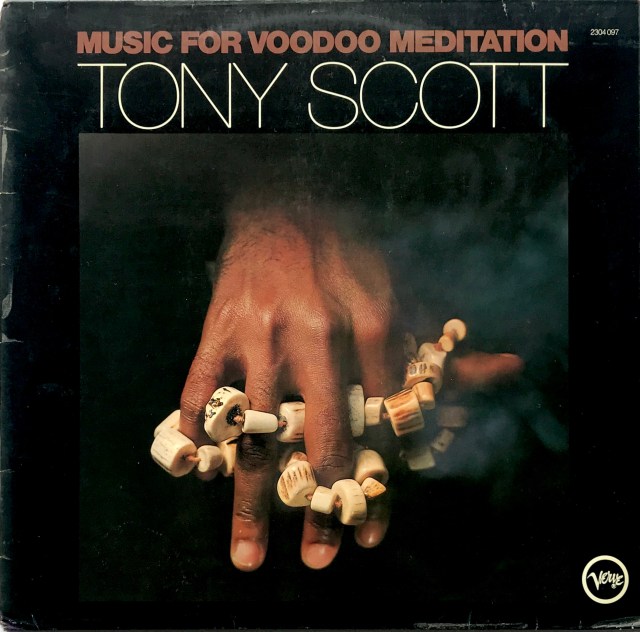
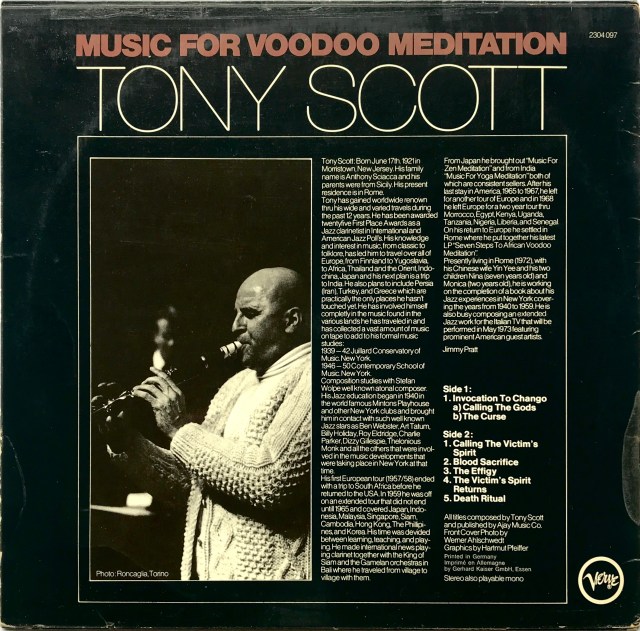
Invitation to Chango:
- Calling the Gods
- The Curse


Calling the victim's spirit
Blood sacrifice
The effigy
The victim's spirit returns
Death ritual
This fabulous slab of rhythmic voodoo-jazz is as peaceful as a midnight ritual in the Haitian jungle.
Percussion opens proceedings, joined by cascading marimba and Scott’s pensive clarinet. They dance, alone yet intertwined; the music is, at first, wistful rather than incantatory. Gods are being invited, welcomed, not commanded. The melody instruments take a break, ceding the ground to gourds and other pattering instruments… “The Curse” weaves a rainstorm of shaking, tapping, and hitting while the clarinet casts a wispy spell.
The suite making up the second part of Music For Voodoo Meditation follows the same music template as part one. There is more tuned percussion (steel drums, I believe) and some of the conga work sounds like drumsticks are being deployed. There is a stronger rhythmic pulse, perhaps reflecting the unpleasant sounding rituals indicated by the track titles. Listening to this music, it is almost impossible not to visualise the climactic scenes of Live And Let Die. Here, the more insistent percussion certainly ups the tension while Scott and his clarinet stand further back.
The final section, “Death ritual” presumably, gathers the complete tribe of percussionists for a final ecstatic dance; congas, marimba, shakers, that twisty thing on a stick™, cow bell. Again, the clarinet has retreated to observer status as if shy of the primitive power of this rhythmic storm.
It’s an exhilarating thirty-four minutes.

™ My young research assistant tells me it’s a cabasa.
No reviews of this album could be located, nor any information on musicians other than the leader.
Apart from a French re-issue in 1976, the vinyl has all but disappeared. It has never been released on CD and is not on Spotify, though the complete LP is on youtube. I suspect malign forces are at work.


 vinylconnection.com.au
I only have one of these. I did not know it was a trilogy, and I definitely did not know one was voodoo lol.
LikeLiked by 1 person
It’s a bit weird, for sure. But an interesting and atmospheric album too!
LikeLike
I’m interested, never seen one in the wild.
LikeLiked by 1 person
For some reason, both Apple Music and Spotify only have “Music for Zen Meditation” and “Music for Yoga Meditation”. Maybe they thought the voodoo stuff is too scary? 🙂
The zen and yoga meditations sound quite relaxing, based on sampling a few tracks of each.
LikeLiked by 1 person
Yes, they are. The ‘Zen’ one is particularly lovely. It’s the later, third instalment that rather changes the ambience. I put the youtube link in the post if you wish to have a listen, Christian.
LikeLiked by 1 person
Thanks, Bruce, I should have checked YouTube where I just found a clip of supposedly the entire album. Gonna check it out! 🙂
LikeLiked by 1 person
Yep. That’s the one I linked to I think.
LikeLiked by 1 person
If it’s not on Spotify then you must have made it up for your own devilment. Just like Neil Young.
LikeLiked by 1 person
Bwah ha ha..!!
LikeLiked by 1 person
Enjoyed your write-up and listened to the album on YouTube. It was quite enjoyable really and didn’t give me too much of a creepy vibe, or induce a zombie-like state as far as I’m aware, just appreciated the rattling rhythms. I did have the urge to sacrifice a rooster but just because I’d like some chicken soup. I read a bit about Scott, I’d never heard of him before, and saw he played for a time with one of Benito Mussolini’s sons, Romano. And thought you’d enjoy the reviewer of Romano’s playing, in the Atlantic Monthly: “Occasionally inspired, he was always efficient; he made the refrains run on time.”
LikeLiked by 1 person
Well, there is some fascinating data, right there. Thank you Robert. I suppose I can’t hold you accountable for the lamentable pun, but I do hope the soup was nourishing.
PS. Tony Scott also made an album with Jan Akkerman, ace guitarist for Dutch progressive band Focus. It’s good, too.
LikeLiked by 1 person