
The Wild Bunch was an ultra-violent 1969 Western movie directed by Sam Peckinpah. It was also the name of a Bristol (UK) sound system collective active in the early-to-mid 1980s. Adopting Jamaican sound system principles, the DJ tribe drew from reggae and dub, funk, punk, soul, early hip-hop and club culture. After the Wild Bunch dissolved, several key participants carried that open-eared, collaborative approach into Massive Attack. Their debut album, Blue Lines, arrived in 1991 and is considered the founding document of what critics would soon call “trip-hop” (though the band always resisted that label).
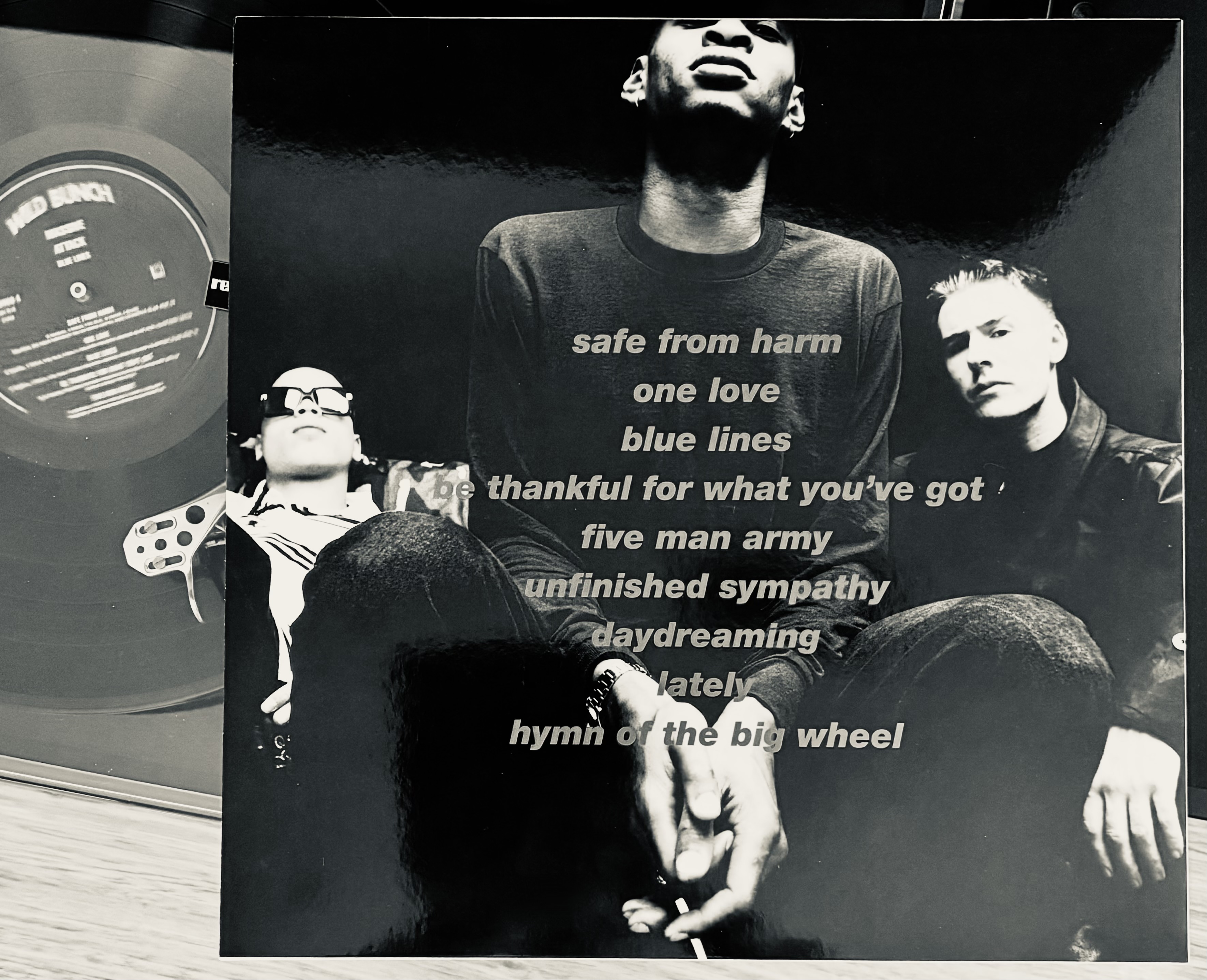
Musically, “Blue Lines” fused hip-hop’s sampling and beat sensibility with reggae/dub bass weight, soul and jazz atmospherics, and a slow, smoked-out tempo that felt completely different from the upbeat rap and house dominating charts at the time. Rather than a single front person, the record rotates vocalists — 3D and Daddy G rapping, Shara Nelson singing with aching soul power, reggae legend Horace Andy contributing his unmistakable falsetto, and Tricky (then an unknown local) delivering strange, mumbled verses that hinted at his own future career. No single voice or genre dominates the record.
What makes Blue Lines special is how it holds contradictory moods in balance. It is simultaneously cool and unsettling, minimal and dense, danceable and introspective. The production — largely managed by engineer Jonny Dollar — favours space over clutter, letting samples breathe rather than piling them up. There’s a paranoid, nocturnal quality running underneath the smoothness, a sense of menace beneath the lounge-y surface, which is part of why it still sounds vital rather than dated.
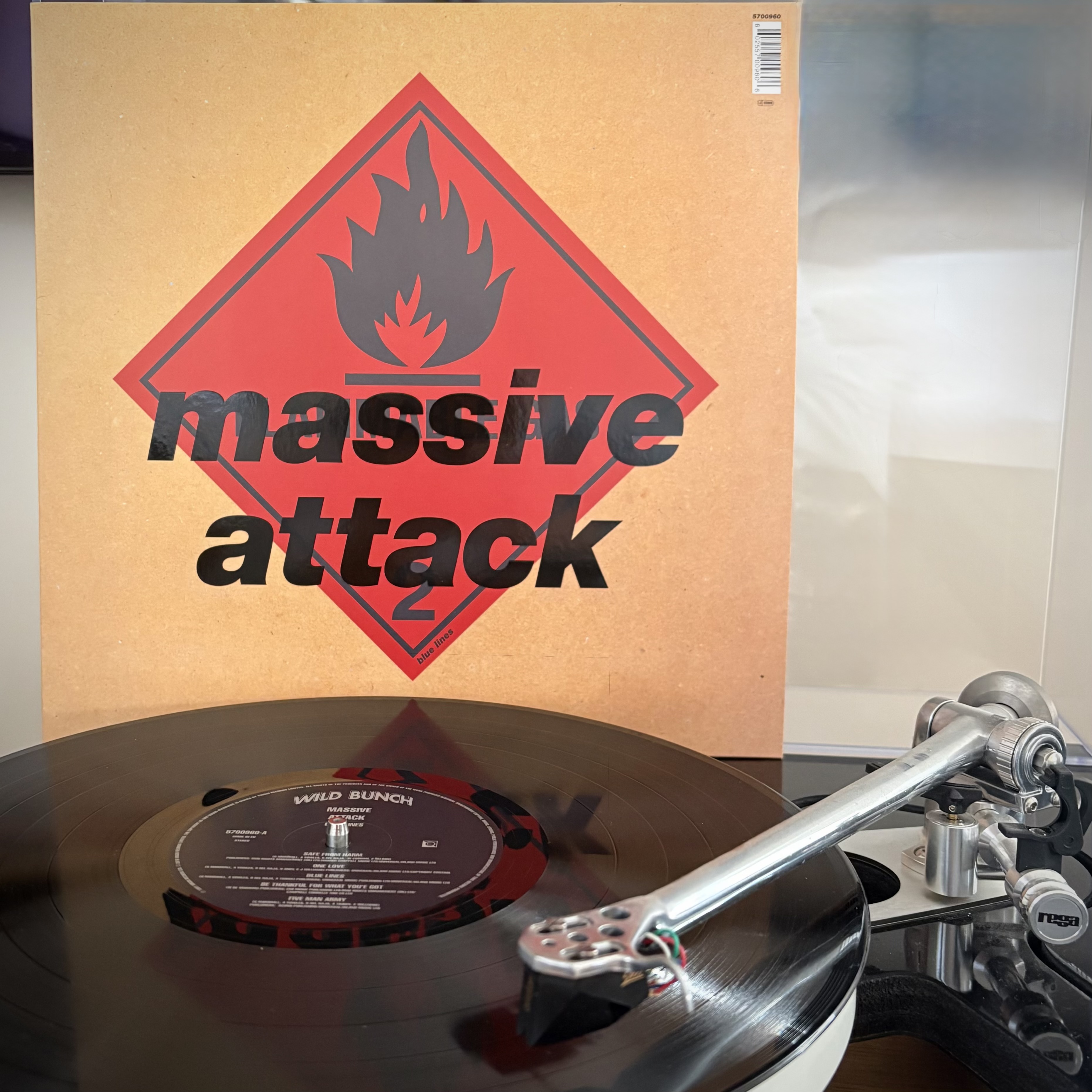
“Safe From Harm” is the perfect introduction. Its opening bassline — built from Billy Cobham’s “Stratus”— is dark and almost physical, while Shara Nelson’s vocal somehow manages to be both languid and edgy. The track’s promise of protection carries a faint threat: safety is something desired because danger is nearby. Del Naja’s spoken interjections make the arrangement feel less like a conventional soul song than a fragment of private conversation overheard in a club at closing time. It establishes the album’s key contradiction: smoothness with edge.
Then there is “Unfinished Sympathy,” the album’s most famous moment and still one of the great singles of the 1990s. Nelson sings it with wounded clarity, turning a story of imperfect love into something grand and immediate. Behind her, the track’s programmed beat and scratches meet a real orchestral string arrangement — recorded at Abbey Road because synthesised strings felt inadequate. The result is startling: neither traditional soul ballad nor dance track, but a union of street-level rhythm and cinematic yearning.
“Five Man Army” makes the group’s dub and reggae inheritance most explicit. Horace Andy’s distinctive falsetto carries the melody over echoing guitar, clattering percussion and a rhythm that seems deliberately unhurried. It feels communal rather than showy, an example of how Massive Attack treated guest vocalists not as decorative features but as essential colours in a larger palette. “Hymn of the Big Wheel,” with Horace Andy again at the microphone, closes the album on an even wider scale: spiritual, reflective and subtly global in its musical reach. Its repeated idea that “the big wheel keeps on turning” gives the song the gravity of a hymn without losing the album’s low-lit sensuality.
At the time, Blue Lines helped demonstrate that British hip-hop-adjacent music did not need to adopt an American template to be vital. It offered a blueprint for later Bristol artists including Portishead and Tricky, while influencing musicians far beyond any genre tag.
The album remains special because it has not fossilised into “the first trip-hop record.” Its production remains tactile, its moods still elusive, and its guests still sound like real people rather than marketing calculations. Blue Lines is an album of atmosphere: cool on the surface, intense at the core, and foundational without ever sounding like a museum piece.
*
This final album review for Discrepancy Records was posted last week. Across almost seven years I wrote about 269 albums, everything from Metallica to Beth Orton, The Beatles to Massive Attack. I previewed RSD release lists and constructed more than a hundred and fifty artist introductions for the web site, a task, I should note in passing, made entirely obsolete by AI.
It was a great gig, one I’m grateful for having had for so long. The time during Melbourne lock-downs was particularly memorable, with a new review—often of an unfamiliar artist—going up every Friday.
All good things end, they say, and I’m happy enough to close this enjoyable chapter in my writing life. Not everyone gets paid to pursue their hobby, with ‘free’ records to boot. With this second crack at retirement, perhaps there will be more energy for Vinyl Connection. We’ll see. Might depend on whether there is anyone still listening, out there in the blogosphere…
*


keep it up Bruce. I enjoy your work!
cheers, Dave
LikeLiked by 2 people
Thanks Dave!
LikeLiked by 1 person
An enticing review, Bruce. It might even tempt a rapsceptic like me to seek this one out. Indeed that ability to lead people to and through an album has been the hallmark of VC, thus far. With luck you’ll continue – to our mutual satisfaction.
Thanks,
DD
LikeLiked by 2 people
Definitely worth sampling, this album. I’ve been playing it even after writing the piece, which is an endorsement in and of itself. And Ms Connection has approved, too! 😉
Much appreciated DD.
LikeLiked by 2 people
I’m still listening! What a run, lovely piece and tribute to 269 (!) reviews. Wow! And I like the Billy Cobham link there from a recent chat we had. The song “Sly” came up on my iPod shuffle yesterday, from Protection, and I’ll always have fond memories of that record from 1994. Be well Bruce, and onward! More at the VC, please…or LK as it were.
LikeLiked by 2 people
Cheers, Bill. The first two Billy Cobham albums are fantastic. And having enjoyed Blue Lines so much, I reckon it’s time to pull out Protection for another listen too!
LikeLiked by 1 person
A representative from that label gave me a free cassette of Protection for agreeing to play/promote the CD in the overhead music system at a cafe I managed in Pittsburgh. Seems like a very different time and age, 32 years ago I guess it was!
LikeLiked by 1 person
Coffee payola. Brilliant.
LikeLiked by 1 person
So many reviews of bands, albums and musicians are simply strings of references to other artists. Whatever random memories were jogged in the reviewers’ minds are treated as insights. Your reviews are always something else entirely, cogent analyses accompanied by real appreciation. And very enjoyable reading!
LikeLiked by 1 person
That’s very kind, Robert. Thank you so much for such thoughtful feedback.
LikeLike
First of all, great seeing you back in the blogospehere, Bruce, and I hope we’ll see more from you! While AI undoubtedly can do a lot, and it’s still getting better, it can’t replace a writer’s judgement and personality.
I’m all new to Massive Attack. “Blue Lines” clearly falls outside my core wheelhouse. But if anything, that core wheelhouse has become much bigger since I started blogging 10 years ago, and that’s in no small part because of fellow bloggers like you, who introduce me to new music. Based on my initial impression, there is something intriguing about “Blue Lines.”
LikeLiked by 1 person
When blogging about music is a two-way street, that’s when it’s most alive, I reckon. Thanks for those thoughts, Christian. And yes, there is something curiously beguiling about Blue Lines.
LikeLiked by 1 person
Such a great singles band, I need to spend more time with the albums. Nice to have you back.
LikeLiked by 1 person
Thanks Graham. Yes, after really enjoying the debut I spent some time with Mezzanine as well: excellent!
LikeLike
You might actually be the first person I know who has been replaced by AI. Which is totally missing the point and value of the of the easy humanity, love and deep personal knowledge you bring to all your writing – plus that one time you put Lego on an album over, despite knowing that was MY THING!! AI would never do that to me.
Keep at it Bruce, I’ll miss you otherwise.
LikeLiked by 2 people
Thank you Joe. 💙
(Though I think your confidence in not being ghosted by ChatGPT is wildly optimistic)
LikeLiked by 1 person